Tuesday, May 31, 2016

Thursday, May 12, 2016
Monuments

The main structural work was completed at the end of March 1889 and, on 31 March, Eiffel celebrated by leading a group of government officials, accompanied by representatives of the press, to the top of the tower.[12] Because the lifts were not yet in operation, the ascent was made by foot, and took over an hour, with Eiffel stopping frequently to explain various features. Most of the party chose to stop at the lower levels, but a few, including the structural engineer, Émile Nouguier, the head of construction, Jean Compagnon, the President of the City Council, and reporters from Le Figaro and Le Monde Illustré, completed the ascent. At 2:35 pm, Eiffel hoisted a large Tricolour to the accompaniment of a 25-gun salute fired at the first level. -- Wikipedia
- Des oiseaux - the birds
- Des arbres - the trees
- Des voitures - the cars
- Métal - metal
- Une rivière - a river

The Louvre or the Louvre Museum is one of the world's largest museums and a historic monument in Paris, France. A central landmark of the city, it is located on the Right Bank of the Seine in the 1st arrondissement (ward). Nearly 35,000 objects from prehistory to the 21st century are exhibited over an area of 60,600 square metres (652,300 square feet). The Louvre is the world's most visited museum after the Palace Museum in China, receiving more than 9.26 million visitors in 2014.[1] It is also one of the largest.
- La fountaine - the fountain
- Des statues - the statues
- La verrière - Glass
- Des visiteurs - Tourists
- Un peu d'art égyptien - some Egyptian art
 The Arc de Triomphe Paris was built between 1806 and 1836. Even though there were many modifications from the original plans, reflecting political changes and power struggles, the Arch still retains the essence of the original concept which was a powerful, unified ensemble.
- Les coureur cyclistes
- Un drapeau - A flag
- beaucoup de gens - lots of people
- Les bus - busses
- Feu - fire

The Sacré-Cœur Basilica was designed by Paul Abadie. Construction began in 1875 and was finished in 1914. It was consecrated after the end of World War I in 1919.
- Coivre - Copper
- Brique en pierre - Stone brick
- Le croix - the crosses
- les lampadaires - the lamp posts
- Une clôture - a fence

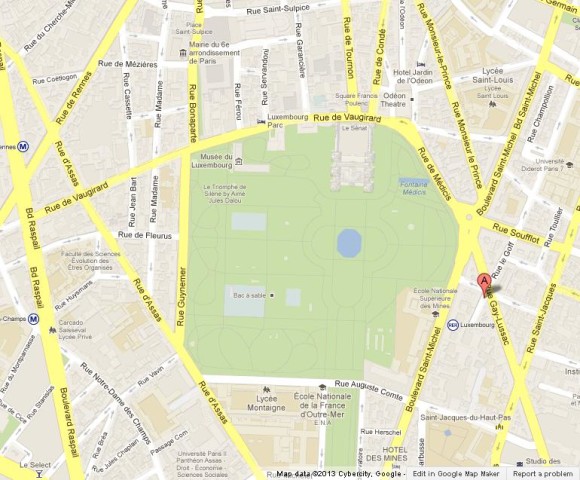
The Jardin du Luxembourg, or the Luxembourg Garden, located in the 6th arrondissement of Paris, was created beginning in 1612 by Marie de' Medici, the widow of King Henry IV of France, for a new residence she constructed, the Luxembourg Palace. The garden today is owned by the French Senate, which meets in the Palace. It covers 23 hectares and is known for its lawns, tree-lined promenades, flowerbeds, the model sailboats on its circular basin, and for the picturesque Medici Fountain, built in 1620.
- Les fleurs
- l'herbe - the grass
- Bancs - benches
- Un parc - a park
- Une rue - a street
Je trouve Blanquette de Veau et la creme brulee

The Musée d'Orsay is a museum in Paris, France, on the left bank of the Seine. It is housed in the former Gare d'Orsay, a Beaux-Arts railway station built between 1898 and 1900. The museum holds mainly French art dating from 1848 to 1914, including paintings, sculptures, furniture, and photography. It houses the largest collection of impressionist and post-Impressionist masterpieces in the world, by painters including Monet, Manet, Degas, Renoir, Cézanne, Seurat, Sisley, Gauguin and Van Gogh. Many of these works were held at the Galerie nationale du Jeu de Paume prior to the museum's opening in 1986. It is one of the largest art museums in Europe.
- Statures
- Beaucoup de peintures - many paintings
- Une horloge - A clock
- Un plafond voûté - An arched ceiling
- Marbre - marble

 Notre dame, a medieval Catholic cathedral on the eastern half of the Île de la Cité in the fourth arrondissement of Paris, France.[3] The cathedral is widely considered to be one of the finest examples of French Gothic architecture, and it is among the largest and most well-known church buildings in the world. The naturalism of its sculptures and stained glass are in contrast with earlier Romanesque architecture.
- Une cathédrale
- La vigne
- Des gargouilles - the gargoyles
- anciens élèves Zalian - former Zalian students
- piliers - pillars
Je trouve Hachis Parmentier et un tarte tropézienne
 When the château was built, Versailles was a country village; today, however, it is a wealthy suburb of Paris, some 20 kilometres (12 miles) southwest of the French capital. The court of Versailles was the centre of political power in France from 1682, when Louis XIV moved from Paris, until the royal family was forced to return to the capital in October 1789 after the beginning of the French Revolution.
- dorure - gilding
- un grand château - a grand castle
- Un majordome - a butler
- Une reine - a queen
- Une guillotine - a guillotine
Je trouve baked camembert et brioche au chocolat

Begun some time after 1238 and consecrated on 26 April 1248, the Sainte-Chapelle is considered among the highest achievements of the Rayonnant period of Gothic architecture. It was commissioned by King Louis IX of France to house his collection of Passion relics, including Christ's Crown of Thorns—one of the most important relics in medieval Christendom.
- imagerie religieuse - religious imagery
- hauts plafonds - tall ceilings
- piliers dorés - gilded pillars
- étoiles d'or - golden stars
- une flèche - a spire

The Palais Garnier is a 1,979-seat opera house, which was built from 1861 to 1875 for the Paris Opera. It was originally called the Salle des Capucines, because of its location on the Boulevard des Capucines in the 9th arrondissement of Paris, but soon became known as the Palais Garnier, in recognition of its opulence and its architect, Charles Garnier.
- Sculptures ornées - ornate carvings
- Grands luminaires - grand lighting fixtures
- Des gens bien habillés - well dressed people
- Chanteurs - singers
Je trouve Pot-au-feu et charlotte aux framboises

Les Invalides, commonly known as Hôtel national des Invalides (The National Residence of the Invalids), or also as Hôtel des Invalides, is a complex of buildings in the 7th arrondissement of Paris, France, containing museums and monuments, all relating to the military history of France, as well as a hospital and a retirement home for war veterans, the building's original purpose. The buildings house the Musée de l'Armée, the military museum of the Army of France, the Musée des Plans-Reliefs, and the Musée d'Histoire Contemporaine, as well as the Dôme des Invalides, a large church with the burial site for some of France's war heroes, most notably Napoleon Bonaparte.
- Une tombe - a grave
- Un bâtiment en forme de dôme - a domed building
- Une Croix D'or - A golden cross
- Les canons - the cannons
- un dôme doré - a guilded dome
Je trouve Magret de Canard et des Napoleons

The Tuileries Garden is a public garden located between the Louvre Museum and the Place de la Concorde in the 1st arrondissement of Paris. Created by Catherine de Medici as the garden of the Tuileries Palace in 1564, it was eventually opened to the public in 1667, and became a public park after the French Revolution. In the 19th and 20th century, it was the place where Parisians celebrated, met, promenaded, and relaxed.
- Le gravier - the gravel
- Certaines personnes de détente - some people relaxing
- Oiseaux de natation - birds swimming
- Feuilles mortes - fallen leaves
- Une grande roue - a ferris wheel
Je trouve Garbure et choux à la crème

The Pont Alexandre III is a deck arch bridge that spans the Seine in Paris. It connects the Champs-Élysées quarter with those of the Invalides and Eiffel Tower. The bridge is widely regarded as the most ornate, extravagant bridge in the city.
- bateaux sur la rivière - boats on the river
Je trouve Cassoulet et Eclair au chocolat
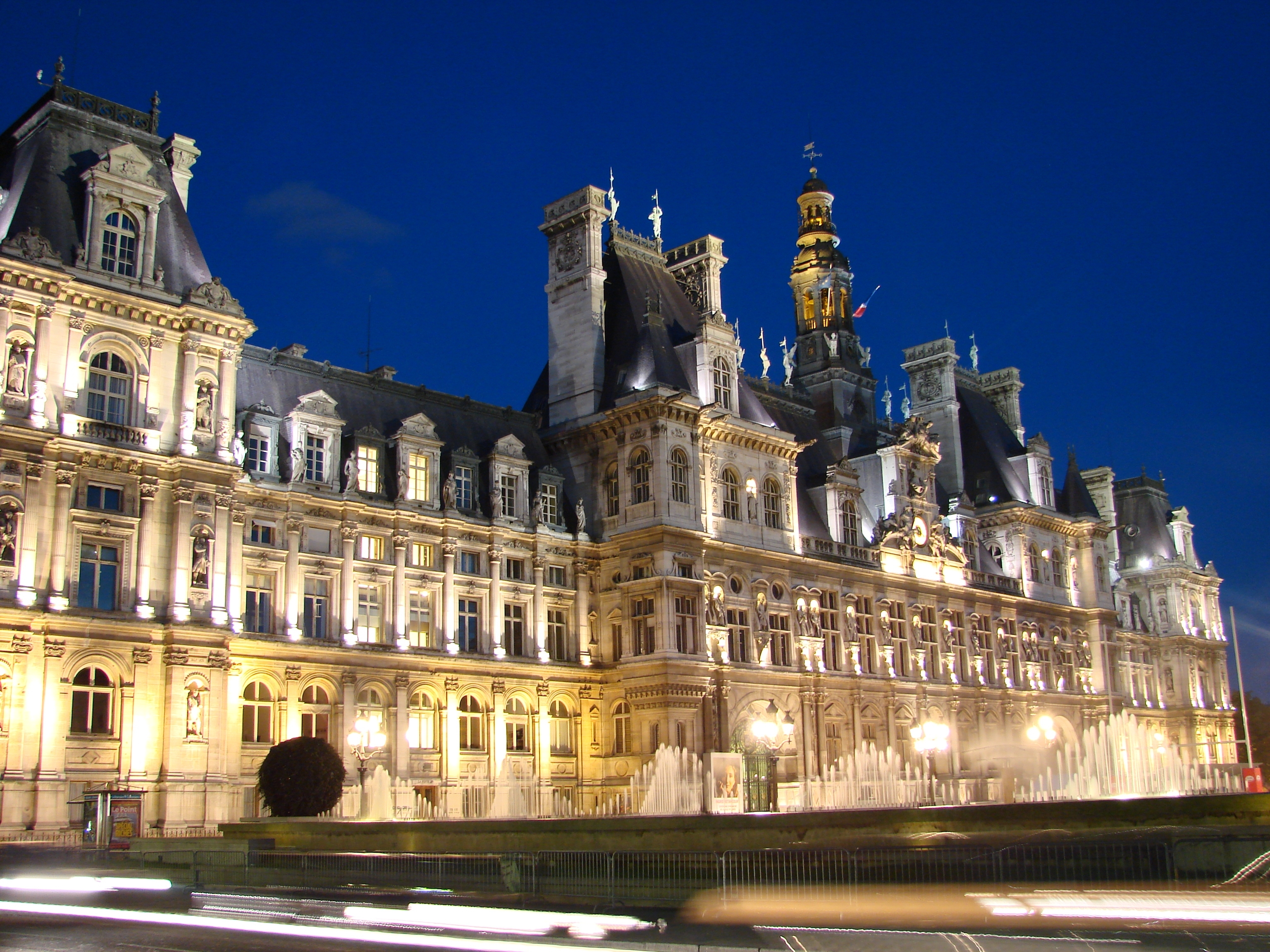
The Hôtel de Ville in Paris, France, is the building housing the city's local administration. Standing on the place de l'Hôtel-de-Ville in the 4th arrondissement, it has been the headquarters of the municipality of Paris since 1357. It serves multiple functions, housing the local administration, the Mayor of Paris (since 1977), and also serves as a venue for large receptions.
Je trouve Confit de Canard et Kouign Amann

Disneyland Paris, originally Euro Disney Resort, is an entertainment resort in Marne-la-Vallée, a new town located 32 km (20 mi) east of the centre of Paris, and is the most visited theme park in all of France and Europe.
- Les personnes ayant le mal des transports - people with motion sickness
- Les gens en costume - people in costume
- Les haies - hedges
- Un château irréaliste - an unrealistic castle
- Une grande souris - a large mouse
Je trouve Poulet Basquaise et Far Breton

The Place de la Concorde is one of the major public squares in Paris, France. Measuring 8.64 hectares (21.3 acres) in area, it is the largest square in the French capital. It is located in the city's eighth arrondissement, at the eastern end of the Champs-Élysées.
Je trouve Soupe de Poisson à la Rouille et Gâteau Basque

The Catacombs of Paris are underground ossuaries in Paris, France which hold the remains of over six million people in a small part of the ancient Mines of Paris tunnel network. Located south of the former city gate "Barrière d’Enfer" beneath Rue de la Tombe-Issoire, the ossuary was founded when city officials were faced with two simultaneous problems: a series of cave-ins starting in 1774 and overflowing cemeteries, particularly Saint Innocents. Nightly processions of bones from 1786 to 1788 transferred remains from cemeteries to the reinforced tunnels, and more remains were added in later years. The underground cemetery became a tourist attraction on a small scale from the early 19th century, and has been open to the public on a regular basis since 1874 with surface access from a building at Place Denfert-Rochereau.
 Known for its student life, lively atmosphere and bistros, the Latin Quarter is the home to a number of higher education establishments besides the university itself, such as the Lang–Martinez Psychiatric Hospital, the École des Mines de Paris, Panthéon-Assas University, the Schola Cantorum, and the Jussieu university campus. Other establishments such as the École Polytechnique have relocated in recent times to more spacious settings.
Je trouve Bouillabaisse et Canelés

Saint-Germain-des-Prés is one of the four administrative quarters of the 6th arrondissement of Paris, France, located around the church of the former Abbey of Saint-Germain-des-Prés. Its official borders are the River Seine on the north, the rue des Saints-Pères on the west, between the rue de Seine and rue Mazarine on the east, and the rue du Four on the south.
Je trouve Soupe au Pistou et Bugnes Lyonnaises

Montmartre is a large hill in Paris's 18th arrondissement. It is 130 metres high and gives its name to the surrounding district, part of the Right Bank in the northern section of the city. The historic district established by the City of Paris in 1995 is bordered by rue Caulaincourt and rue Custine on the north; rue de Clignancourt on the east; boulevard de Clichy and boulevard de Rochechouart to the south.
Je trouve Aligot et Chocolat Religieuse
Tuesday, February 9, 2016
Monday, January 25, 2016

Tuesday, January 12, 2016
Notre fete a Paris
Est-ce que nous allons aller dans une fete?
Oui, nous allons aller dans une fete.
Est-ce que nous allons aller porter de beaux vetements?
Oui, nous allons aller porter de beaux vetements.
Est-ce que nous allons manger de la bonne norriture?
Oui, nous allons manger de la bonne norriture.
Qu'est-ce que nous manger?
Pour le moment, je ne sais pas.
Ou est la fete?
La fete est dans le jardin de luxembourg.


Oui, nous allons aller dans une fete.
Est-ce que nous allons aller porter de beaux vetements?
Oui, nous allons aller porter de beaux vetements.
Est-ce que nous allons manger de la bonne norriture?
Oui, nous allons manger de la bonne norriture.
Qu'est-ce que nous manger?
Pour le moment, je ne sais pas.
Ou est la fete?
La fete est dans le jardin de luxembourg.

Tuesday, December 8, 2015

.jpg)

Subscribe to:
Comments (Atom)